
ISO 22000:2018 Food Safety Management Systems
During last decades, a stream of ample food scandals has given evidence for consumers around the world to have higher concern over the hygiene and safety standard of the food.Numerous reports pertained to supply chain shortcomings has raised enough questions over consumers’ health and safety.Concerning the need for consumer health, additional measures were laid out with the main objective to dramatically reduce or eliminate risks and improve food safety.Such measures caused the producers, processors and food distributors to prove their ability to fulfill the legal requirements in the practice and within the area of safety and hygiene within all food web.
The history of inspection over food safety is long and it all started with the purity testing of brewed drinks during ancient times. However, it was only during 1906 that the concern over food safety began to raise and a law was established, in relation to food safety control in the USA to adopt preventive approach to increase food safety.
ISO 22000 : FSMS?
It is based on process control system and is designed to identify and prevent microbial and other hazards in the entire food chain and includes steps to prevent and detect problems through a systematic way.The standard combines generally recognized key elements to ensure food safety, including:
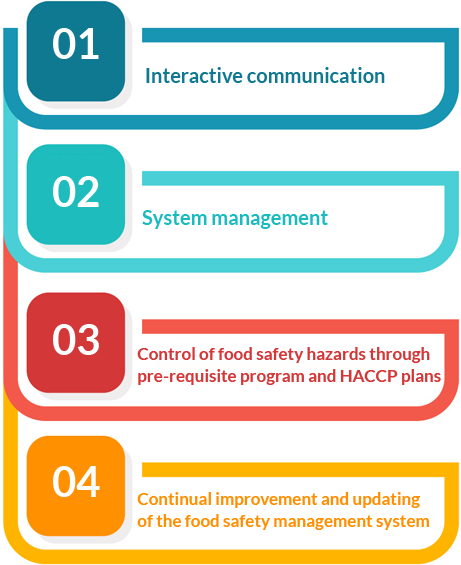
The standard harmonizes various existing national and industry certification schemes that delivers a common global framework of safety requirements for all organizations in the food supply chain, including crop production, processing, distribution, and related operations ensuring food safety
ISO 22000 extends benefits for the management system approach of the ISO 9001 Quality Management System with Hazard Analysis & Critical Control Points to ensure delivery of safe food products to its customers.